


More than 60 percent of businesses struggle to create content that truly engages their target audience. In a world where competition for attention is constantly increasing, relevant and credible content is crucial to building long-term customer relationships. Here you will learn how content marketing works, why it is so effective, and what mistakes you can easily avoid to be more successful with your digital presence.
Table of contents
- What is content marketing and its purpose?
- Different types of content and channels
- How Content Marketing Drives Business Growth
- Common mistakes and how to avoid them
- How to measure success in content
Key insights
| Point | Details |
|---|---|
| Content marketing builds trust | By offering valuable and relevant content, companies can create meaningful relationships with their customers. |
| Different types of content are important | Adapting the content type to the target audience increases engagement and communication effectiveness. |
| Measure success continuously | Use engagement metrics and traffic data to evaluate content effectiveness and adjust strategy. |
| Avoid common mistakes | Make sure the content is original and specific to your target audience to avoid ineffective communication. |
What is content marketing and its purpose?
Content marketing is a strategic marketing approach that involves creating and distributing valuable, relevant, and consistent content to attract and retain a clearly defined audience. The goal is not just to sell products, but to create meaningful relationships by delivering information that helps and inspires the recipients.
The central goal of content marketing is to build trust and credibility with potential customers by offering insightful and useful information. Effective online marketing is based on the principle of helping people rather than just selling. This means that the content must be authentic, valuable and directly connected to the recipient's needs and interests.
When working with content marketing, there are several important components to consider:
- Create content that solves real problems for your target audience
- Be consistent in tone of voice and message
- Adapt content to different channels and platforms
- Measure and follow up on results continuously
For Swedish small businesses and entrepreneurs, content marketing is about building trust through genuine and competent content. It is no longer enough to simply promote products, but you must offer real value that helps potential customers make informed decisions. Social media marketing opportunities plays a crucial role in effectively distributing and exposing this content.
Different types of content and channels
Content marketing offers a variety of content types that can be tailored to different marketing goals and audience preferences. By varying content, companies can create more engaging and effective communication strategies that reach different segments of their audience in a more personalized and targeted way.
Some of the most important content types include:
- Blog post: Informative articles that provide in-depth knowledge
- Video footage: Visual storytelling that explains complex concepts
- Infographics: Visual summaries of data and statistics
- Podcast episode: Audio-based content for in-depth knowledge transfer
- E-books and guides: Comprehensive resources for specialized topics
The role of social media is crucial when it comes to spreading and exposing this content. Each channel has its unique strengths and is suitable for different types of content. Instagram works great for visual material, while LinkedIn is better suited for professional and informative posts.
For small and medium-sized businesses, it's about finding the right balance and understanding where their specific target audience is. Step-by-step social media strategies can help companies systematically develop and implement content plans that generate engagement and build long-term relationships with potential customers.

How Content Marketing Drives Business Growth
Content marketing is a powerful strategy for driving business growth by creating meaningful and valuable content that attracts, engages, and converts potential customers. Unlike traditional marketing, this method focuses on building long-term relationships by offering genuine solutions and insights rather than just selling products.
The key mechanisms of how content marketing drives growth include:
- Improved visibility: High-quality content increases the chances of being visible in search engines
- Trust building: Expert content establishes credibility and industry leadership
- Customer engagement: Relevant content creates deeper connections with potential customers
- Cost-effective marketing: Organic reach compared to traditional advertising
- Leads and conversions: Content that guides customers through the buying journey
Digital tools for sales plays a crucial role in this process by enabling more targeted and measurable communication. Small and medium-sized businesses can particularly benefit from this strategy as it allows them to compete with larger players through intelligent and cost-effective marketing efforts.
Successful content marketing requires continuous analysis and adaptation. By systematically measuring results, understanding audience reactions, and constantly refining their strategy, companies can create a robust marketing approach that not only generates leads but also builds long-term, valuable customer relationships.
Common mistakes and how to avoid them
Content marketing is a complex strategy where many companies get caught up in recurring pitfalls that can undermine their digital communications efforts. By understanding and proactively addressing these challenges, organizations can create more effective and engaging content strategies.
Some of the most common mistakes include:
- Lack of original content: Duplicating or copying content from other sources
- Non-specific target group adaptation: Generic content that doesn't speak directly to the recipients
- Inconsistent publishing: Irregular or sporadic content production
- Lack of measurable goals: Content without clear performance indicators
- Neglecting search engine optimization: Content that is not searchable or indexable
Regarding copywriting and text production it is crucial to create ‘'evergreen content'’ that remains relevant over time. This means avoiding short-term trends and instead focusing on timeless topics and genuine insights that continue to deliver value to readers.
Successful content marketing requires continuous evaluation and adaptation. By systematically analyzing audience response, measuring results, and constantly refining their strategy, companies can create content that not only captures attention but also builds long-term relationships with their target audience.
How to measure success in content
Content marketing success measurement is crucial to understanding the effectiveness of your digital communications strategies. It's not just about producing content, but about systematically evaluating its impact and ability to achieve specific business goals.
Key metrics for content success include:
- Engagement metrics: Likes, shares, comments
- Traffic generation: Visitor numbers and visitor sources
- Conversion rate: Leads and sales generated from the content
- Average read/view time: Actual interest of the audience
- SEO results: Search engine ranking
Digital Marketing ROI Statistics shows that the most successful content strategies combine quantitative measurements with deeper insights into audience behavior. It’s not enough to just have superficial numbers, you need to understand the underlying patterns and motivations.
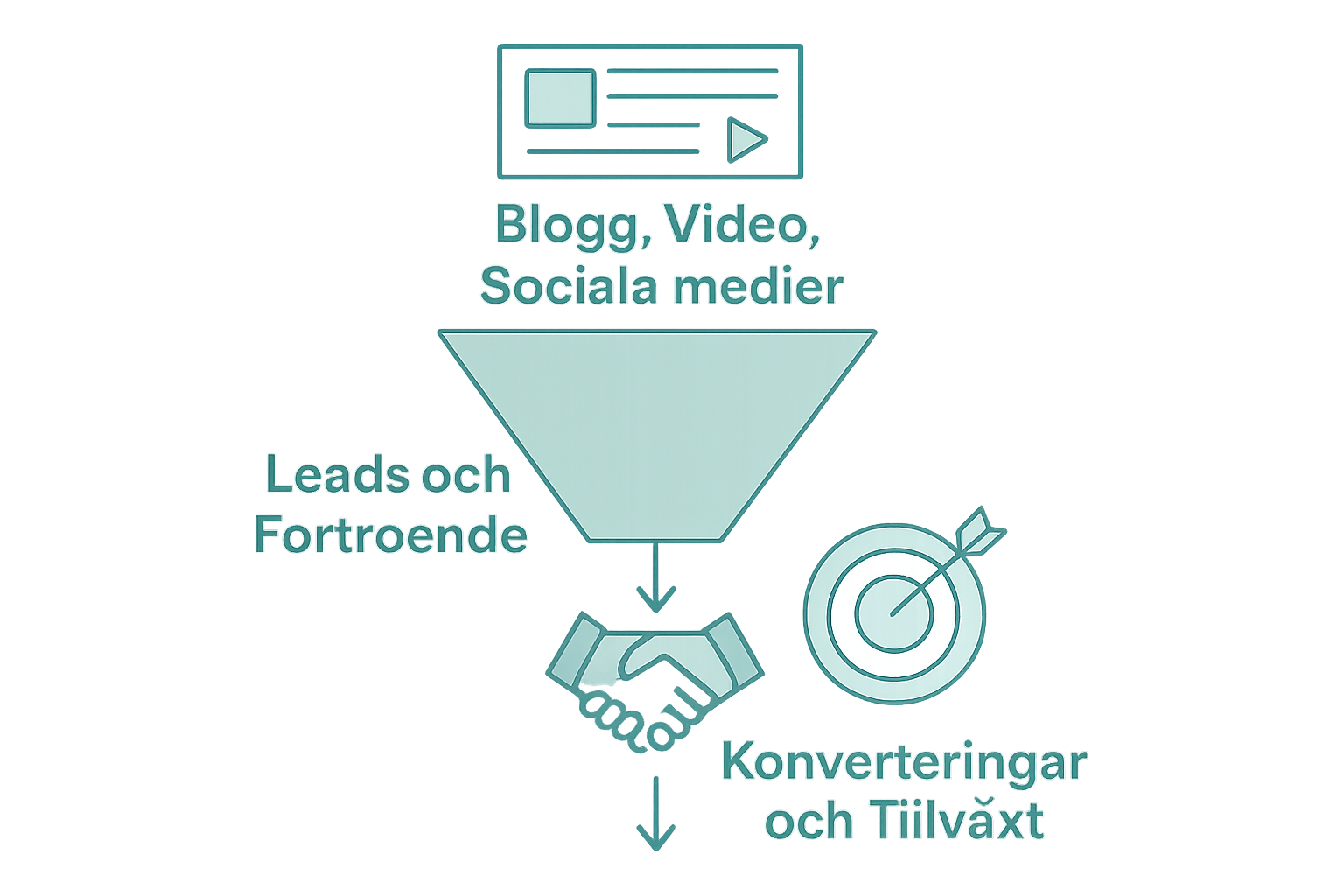
A successful content strategy requires continuous analysis and iteration. By regularly reviewing their results, experimenting with different approaches, and being responsive to audience reactions, companies can develop increasingly refined and effective content marketing methods.
Take control of your content marketing and drive real growth
Do you feel like your content isn’t reaching or creating the lasting connection with your target audience that you want? It’s common to get stuck in a spiral of unspecific content, inconsistent publishing, and a lack of clear goals. By focusing on strategically crafted and targeted messaging, you can build trust and truly increase your visibility. Understanding the power of content marketing and combining it with the right digital tools is crucial to converting visitors into loyal customers.
Do you want to take the next step towards a sustainable and effective digital presence that truly engages? iMarketing.se We offer expert help with everything from copywriting and text production to strategic social media management and search engine optimization. Together we create content that not only gets seen but also converts and builds long-term relationships. Start growing online today by contacting us for a free consultation and take control of your digital future.
Frequently Asked Questions
What is content marketing?
Content marketing is a strategic approach to creating and distributing valuable and relevant content to attract and retain a specific audience. The aim is to build trust and relationships rather than just sell products.
How can small businesses benefit from content marketing?
Small businesses can benefit from content marketing by providing genuine and valuable content that solves problems for their target audience. This builds trust and can lead to increased visibility and more conversions.
What types of content are most effective in content marketing?
Effective types of content include blog posts, videos, infographics, podcast episodes, and e-books. Each type can be customized to reach different audiences and communication goals.
How do you measure the success of your content marketing?
Success is measured through key metrics such as engagement metrics (likes, shares), website traffic, conversion rates, and search engine results. It is important to continuously analyze and adapt the strategy based on the results.


 EN
EN  SE
SE